
Planning the playlist for your wedding or your birthday
The moment-by-moment guide, written by a DJ who has played more than a hundred parties in the Gironde. How many tracks to plan, which ones, at what moment — and how to forget nothing.
You probably already have a dozen songs in mind. The problem is never not knowing what to listen to: it is remembering them on the day you have to make a list. A track crosses your mind in the car, another at a wedding you are invited to, a third that your mother reminds you of on the phone — and three months later, nothing.
This page gives you the method I use with every couple I work with, and the list of moments nobody thinks about until it is too late.
Your private LexPlay space, open from the moment you book
As soon as we work together, I open a private online space, just for the two of you and me. Nothing to install, no account to create: a simple link that opens on your phone as well as on your computer.
You import your Spotify, Apple Music or Deezer playlist in one click, or add your tracks over the months, as they come to you. You organise them by moment, mark your must-plays ★ and your do-not-plays, and prepare the running order of the big day hour by hour. I review everything: I tell you whether a track works at that point in the evening, suggest alternatives, and prepare the edits. No more scattered emails, no more “what did we say for the entrance into the room?”.
- 📥 Playlist import
- 💒 Non-religious ceremony
- 🥂 Cocktail hour
- 🍽️ Dinner
- 🎉 Party and end of the night
- ⭐ Your must-plays
- 🚫 Do-not-play list
- 🕐 Running order of the big day
- 📋 Practical information
Wedding playlist: moment by moment
A wedding day is not one playlist. It is eight or nine different moods that follow one another, and each one calls for something different. Here is how I break them down.
The non-religious ceremony
Three moments to cover: the couple’s entrance, one or two passages during the readings, and the exit. It is the only moment of the day when the music is listened to for its own sake, with no conversation over it — so the choice really matters.
What works: acoustic or piano-and-voice versions of a track that is personal to you. They carry the emotion without drowning out the celebrant’s words.
The cocktail hour
I am behind the decks from the cocktail hour, not only from the evening onwards. Most of the time the music stays in the background: your guests get together, discover the venue, talk. It is the longest moment of the day, and the one couples think about least.
But some groups are frankly festive — and when I feel it coming, I do not hold back. It regularly happens that I get people dancing during the cocktail hour. The floor fills up before dinner, and those are often the days people remember most.
What works: soul, vocal jazz, bossa nova, acoustic pop or gentle covers of well-known tracks to set the mood — then more rhythmic tracks as soon as the first guests start to move.
The entrance into the room
Your first appearance in front of everyone gathered together. And with me, nobody watches it sitting down: I get the room on its feet on the mic and form a guard of honour, so that you walk in among your guests rather than in front of them. You do not cross a silent room, you walk into an ovation.
So the track must start strong — no forty-second intro — and last long enough for you to walk the length of the guard of honour.
What works: a track with rhythm from the very first second, or a cult song the room recognises in three notes and claps along to — the effect is even stronger when everyone is already standing.
The dinner
At the table, I start with lounge and above all tracks everyone knows, but in violin or piano versions. That is what works best during a meal: you recognise the melody without thinking about it, you hum along, and conversations carry on quietly over it.
Then we build gently course by course. By the time dessert arrives, the mood should already make people want to get up.
What works: instrumental covers of well-known tracks, lounge, mellow soul — then a gradual shift towards more rhythmic tracks, with no abrupt break between the starter and dessert.
The first dance
The only moment when every eye and every phone is pointed at you. A classic slow dance, a rehearsed choreography or a surprise medley: all three work, provided they have been rehearsed.
What works: a slow song you know by heart, or a medley that switches after a minute to something festive to bring everyone onto the floor.
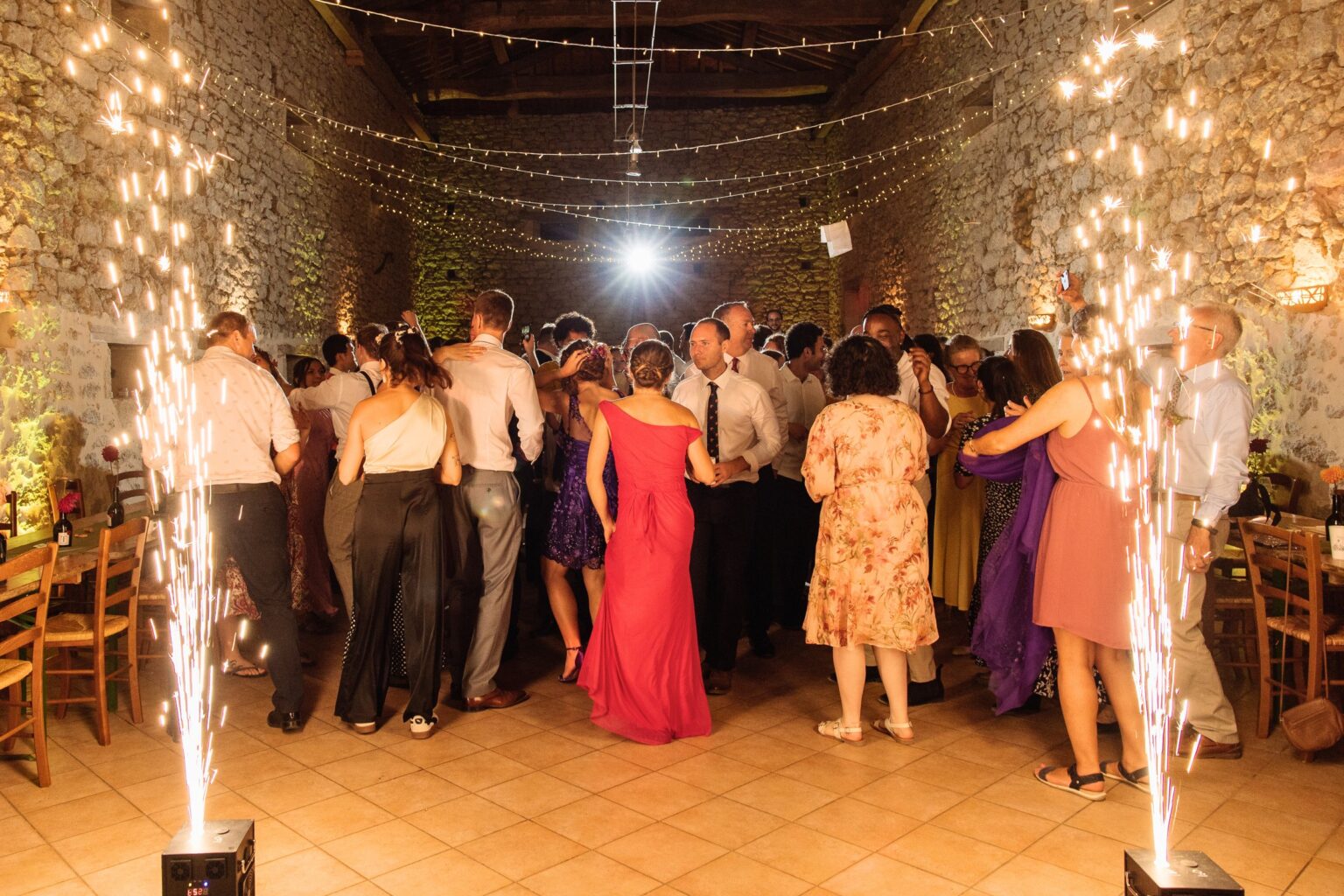
The cake music
The arrival of the cake is a moment of theatre. The music should be big, a little solemn or downright festive depending on your style.
What works: a track that builds in power, synchronised with the waiters’ entrance into the room.
The bouquet toss and the saucisson toss
Two playful moments, two different pieces of music. And yes, the saucisson toss: we are in the South-West, and it is a moment that always gets a laugh.
What works: for the bouquet, a catchy pop track the singles know. For the saucisson, something bold and a little absurd — the comic effect does half the work.
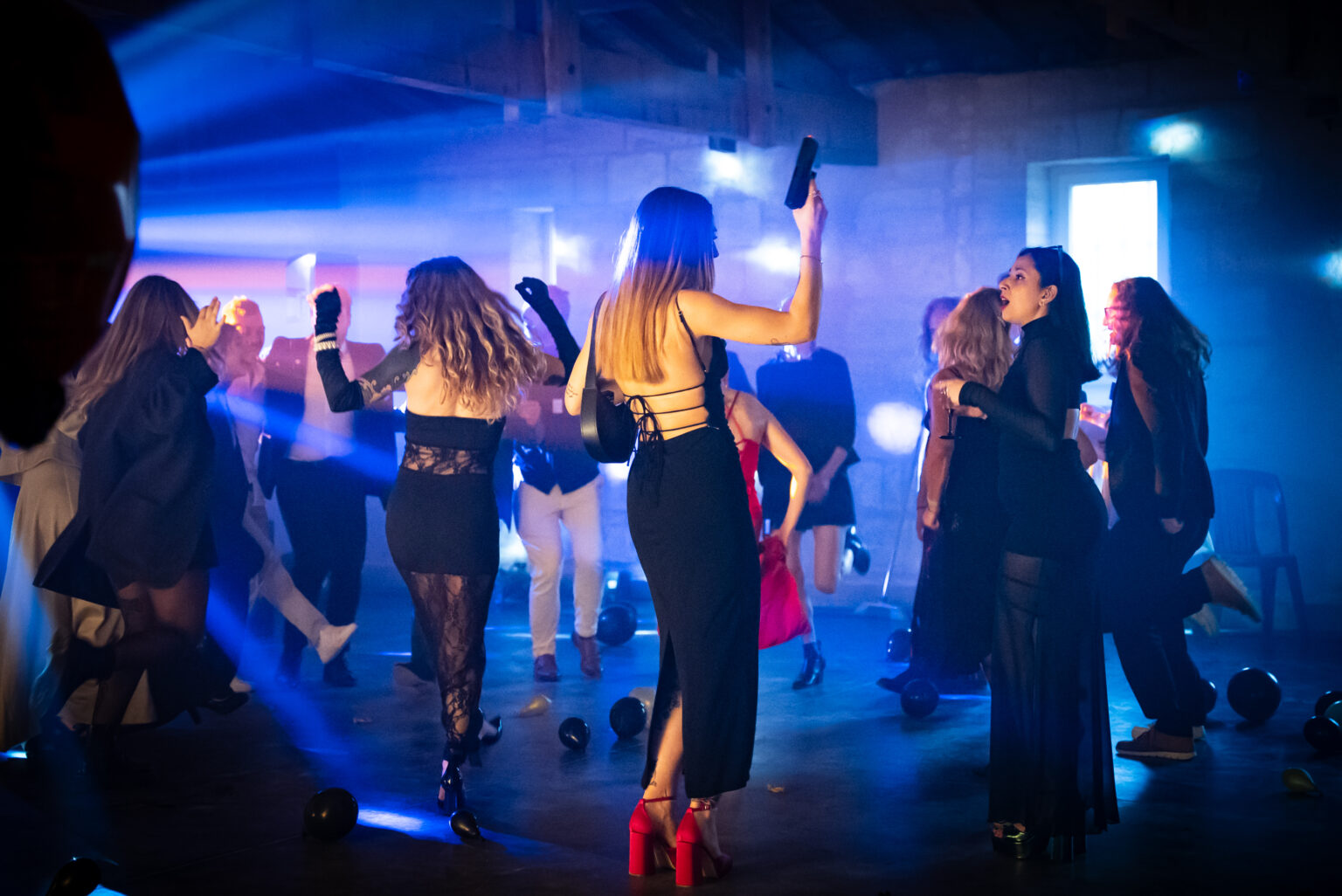
The dance party
This is the part I do not fully prepare in advance, and that is deliberate. I read the room and adapt live — who is on the floor, who is hesitating at the edge, which generation is starting to drift away.
What works: what I want from you is your must-plays and your do-not-plays. The rest I build according to what is really happening in the room.
Birthday playlist: it depends on the age
For a birthday there are no set moments as at a wedding. What changes everything is the age of the person being celebrated and that of the guests. The same playlist that is a hit at a 30th will empty the floor at a 60th, and vice versa.
18th and 20th birthdays
Everyone is the same age with the same references: it is the simplest case. The repertoire is current, the floor fills up early and never empties.
What works: the releases of the last two years, rap, afrobeat, electro. And two or three tracks from secondary school for the nostalgia effect.
30th and 40th birthdays
This is the age at which nostalgia works best. Your guests want to hear again what they listened to at twenty, and they want to sing it loud.
What works: the hits of the 2000s and 2010s, RnB, dancehall, and the French classics that get the whole room singing.
50th and 60th birthdays
You will have your friends and your children, sometimes your parents. The challenge is not finding tracks, it is making three repertoires coexist without anyone leaving the floor.
What works: disco, funk, French pop, 70s and 80s rock — and modern remixes of those same tracks so that the younger ones follow.
Surprise parties
Everything rests on the moment the person walks into the room. You need a track that starts on the second, and total silence just before.
What works: a track that means something to them, or a party classic everyone sings along to from the first note.
The do-not-play list: the most useful list of all
It is often the part couples fill in the fastest, and by far the most precious for me. A track that reminds someone of an ex, the song from a recent funeral, the tune a guest cannot stand: I cannot guess it, but I can avoid it if I know.
The “Do not play” list in your private space is exactly for that. You drop a track in without having to explain why, and I remove it from the evening for good.
How many tracks should you give me?
Fewer than you think. Around twenty must-plays and a dozen do-not-plays are enough for me to build a whole evening. Beyond that, you spend a lot of time for a very similar result: a lively party is largely built in the moment, according to what is really happening in the room.
What I want from you is what I cannot guess: the tracks that matter to you, your do-not-plays, and the moments you want to mark. The rest is my job.
Frequently asked questions about musical preparation
How far in advance should we prepare our playlist?
There is no deadline, and that is the whole point of your private space: you import your playlist or add your tracks over the months, from the moment you sign. We take stock together about a month before the date, at the preparation meeting. A couple who start six months ahead always arrive calmer than a couple who do it all in three evenings.
Do we need to give you the complete list of music for the evening?
It is not necessary. Around twenty must-play tracks and a dozen do-not-plays are more than enough. A party is built as much by reading the room in the moment as by following a list prepared in advance.
What if a track we love does not work on a dance floor?
I tell you frankly, and I suggest an alternative — often another version of the same track. Some tracks that are magnificent to listen to are simply not made for a dance floor — and many exist in remixed versions you do not know yet.
Can we ask you for a custom edit or medley?
Yes, it is included. First dance, surprise medley, mix for a flash mob: I edit it from the tracks you add to your private space. It is actually one of the most frequent uses.
Do we need to install an app? Is it paid?
No, and it is free: it is a simple private link that opens in the browser of your phone or computer, with no account to create. There is only the two of you and me, and it is included in all my wedding packages.
Is this service reserved for weddings?
No. The private space is included in all my wedding packages, and I also open it for birthdays and corporate parties whenever the musical preparation warrants it.
We start with your date
First check that I am free, then we talk music. Your private space opens from the moment you sign, and you have all the remaining months to fill it at your own pace.
Get my free quoteAlso worth reading: the wedding activities that really work · my wedding DJ packages in Bordeaux · Birthday DJ in Bordeaux